


“Foresight means equipping yourself with the means to achieve a form of clear-eyed optimism. Everything has already been said about the world to come in terms of resources; now we need to implement strategies. Foresight must leave its mark on the strategic calendar of leaders, otherwise it is just pie in the sky.“ Thomas Gauthier, professor and holder of the Carbon4 Finance ”Strategy in the Anthropocene” chair at emlyon business school.
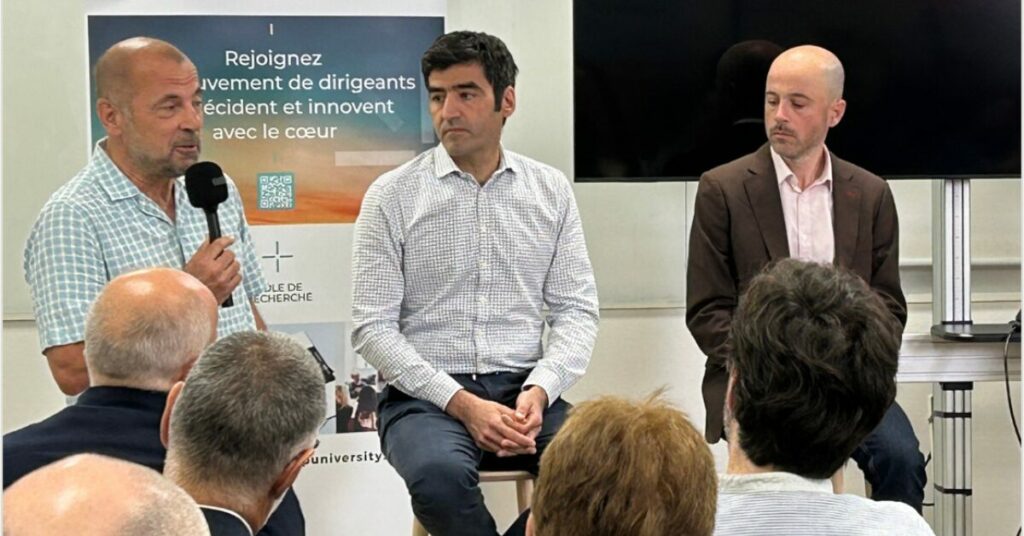
Around thirty leaders gathered at the Palais de la Bourse, on the premises of the Institut Louis Bachelier and Enerdata, to discuss foresight.
In his introduction to the morning’s proceedings, Philippe DA COSTA, President of the French Red Cross, explained that the Red Cross had set up a foresight steering committee and that it was urgent to be better prepared in a context of multiple crises.
The first round table, “Prospects and Physical Limits,” brought together Pascal Charriau, President of Enerdata, Michael Haddad, Director of Innovation & Partnerships at Alstom, and Thomas Gauthier.
“We participated in the development of ADEME scenarios to imagine the world in 2030 from a resource perspective. These scenarios are very useful for leaders. Pascal Charriau
“The 1972 Meadows Report had already anticipated a world facing resource shortages. It was revisited in 2022 and the trajectory has been confirmed. We are heading towards the collapse of the world as we know it around 2040.” Michael Haddad
The second round table gave the floor to two leaders who participated in our foresight & AI workshops, led by Pierre-Antoine Marti of Futuribles International in partnership with the CJD:
“I did not expect the in-depth reflections generated by these workshops,” Michel Paillet, from the Observatoire de l’Evolution des Métiers de l’Assurance.
“This workshop crystallized the weak signals I was perceiving and also allowed us to see what we had carefully forgotten to look at.” Damien Thouvenin, co-founder of Goood!.
In conclusion, Dr. Jean-Michel Valantin, PhD, author of the book “Hyperwar, How AI is Revolutionizing Warfare,” reminded us that “The future is not a reflection of the present” and invited us to read or reread “The Black Swan: The Impact of the Highly Improbable” by Nassim Nicholas Taleb.